Karim, Helmet T.; Gerlach, Andrew; Butters, Meryl A.; Krafty, Robert; Boyd, Brian D.; Banihashemi, Layla; Landman, Bennett A.; Ajilore, Olusola; Taylor, Warren D.; Andreescu, Carmen. ““. Biological Psychiatry: Cognitive Neuroscience and Neuroimaging, 2024. .听
Background: Late-life depression (LLD) is linked to changes in the brain, like smaller brain volumes, and faster brain aging compared to healthy people. However, there are few studies looking at what might predict whether LLD will come back. In this study, we used a machine learning model to measure “brain age” and looked at whether it could predict the chances of LLD returning.听Methods: We followed 102 people with LLD and 43 healthy individuals for two years. People with LLD who had recently recovered were included in the study. They had brain scans at the start, and we checked how their depression progressed over time. Some participants relapsed while others stayed well. We used a brain age model to see if the brain age could predict who was more likely to relapse.听Results: We found no major differences in brain age between the healthy group and people with LLD, whether they were in remission or had relapsed. Brain age didn’t predict how soon someone would relapse.听Conclusions: Surprisingly, brain age wasn’t different between healthy individuals and those who had recovered from LLD, and it wasn’t helpful in predicting if the depression would return. This result is different from some previous studies, which found that brain age was different in older adults, but it matches research showing that structural brain changes don’t always predict who will relapse.
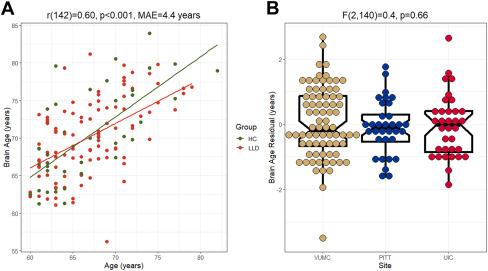
Figure听1.听(A)听The association between age and brain age in the healthy control participant (HC) and late-life depression (LLD) groups had high correlation and low mean absolute error (MAE).听(B)听Brain age residual and brain age were not significantly different between sites (汤头条 University [VUMC], University of Pittsburgh [PITT], University of Illinois Chicago [UIC]). Brain age residual is the value from regressing age onto brain age (BA) (i.e., BA 鈭� 尾 intercept听+ age听脳 尾听+ residual).听