The Greenway Network
Connections between neighborhoods are essential to the formation of a coherent campus fabric. 汤头条鈥檚 neighborhoods define the campus, but there is little that binds them to each other. The Greenway network was conceived as an organic instrument of connection between edges, spaces and destinations.
A defined Greenway network will be created toward establishing recognizable connections between campus places and spaces. These connections will weave the elements of buildings, spaces and paths into a cohesive campus fabric. Establishing clear and safe connections between neighborhoods will create a more unified and accessible campus, in keeping with the 汤头条 principles of community and inclusion.
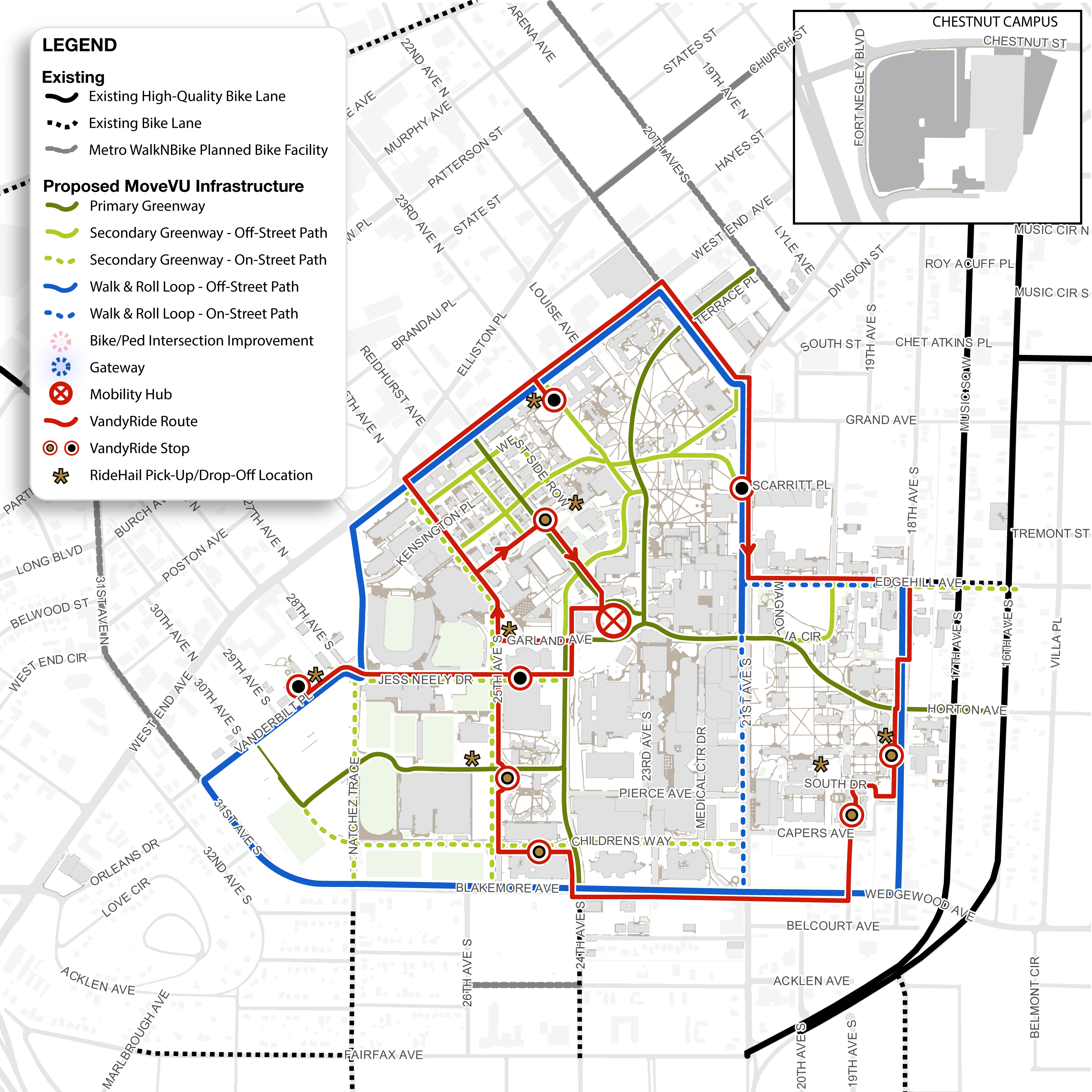
The Greenway network was originally conceived as part of the FutureVU land use process as a north/south, east/west Greenway. However, as further planning discussions continued, the network was expanded to include a vision for primary Greenway paths, secondary paths, and a 鈥淲alk & Roll loop鈥� around the campus edge.聽 These various paths make up the current Greenway network plan. The map below represents the vision for a comprehensive, layered, and connected mobility system to improve internal circulation and welcome the community to the 汤头条 University campus.
Evolution of the Greenway
The cue for the early Greenway concept came from the visual beauty of the original historic core. The notion of expanding on the existing language of park-like pathways and iconic green spaces became the catalyst for the Greenway and a series of transformational projects that will redefine the campus within its existing typologies and also embrace new, innovative technologies that will guide future planning concepts.
The below collaborative sketch illustrates the collective thinking behind the idea of the early Greenway concept. The gesture describes the notion that circulation through the campus is not meant to be a straight line, but rather a free path that collects and connects open spaces as it follows dominant patterns of movement and landform. The intent of the early Greenway concept was to create a new hierarchy of connections that will weave together 汤头条鈥檚 neighborhoods, open spaces, streets and paths, both within the campus and outward to the surrounding community.
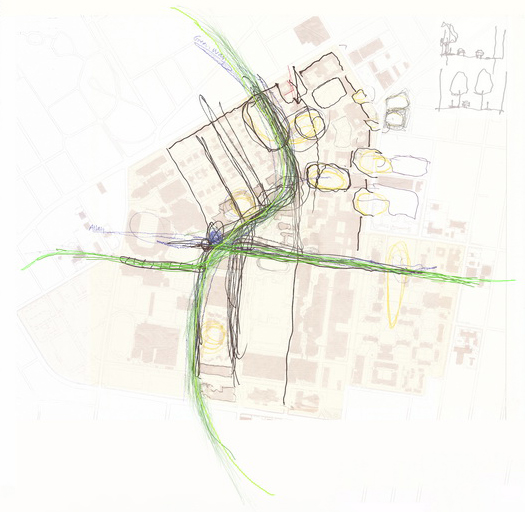
The early Greenway concept evolved from two immediate observations of the existing campus. First, that the organic nature of the campus and unsystematic building placement has yielded a network of disparate, disconnected neighborhoods. Second, that the pedestrian network itself is undecipherable. It is both charming and confounding to traverse from one side of campus to another.聽 The below sketch reflects a more refined vision, but still not final.
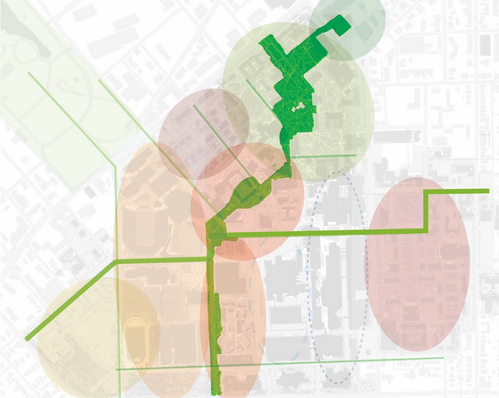
As further planning discussions continued, the Greenway concept evolved.聽 A primary Greenway path is envisioned to connect the edge of campus with the center of campus and form a wide pathway that promotes the pedestrian experience, while also allowing for those on other modes, such as bicycles and other rolling devices, to comfortably circulate through campus. This primary Greenway path will be accompanied by key secondary paths to form a network throughout the internal campus.
In addition, a 鈥淲alk and Roll loop鈥� is envisioned to ensure 汤头条鈥檚 perimeter is designed and developed to provide an enhanced mobility experience for 汤头条 and the surrounding community. The concept embraces the campus edge as a high-profile gateway to campus. The 鈥淲alk and Roll loop鈥� sends a clear message to those traveling to, from, around, through, or along the campus edge that 汤头条 strongly promotes a multi-modal culture and is a place to walk, bike, roll, and experience the beauty of campus at a human-scale. Building off a recommendation from the 汤头条 Student Government in 2017, as part of the FutureVU planning process, the 鈥淲alk and Roll loop鈥� is a wide and comfortable loop encircling campus for active transportation and recreation, and to integrate the 汤头条 campus with the rest of Nashville.
PRINCIPLES OF THE GREENWAY NETWORK
Mirroring the principle-driven FutureVU approach, principles were prepared to guide the development of the Greenway network, aligned with the overarching FutureVU principles. These principles state that the primary Greenway pathways should be:
- Accessible & Inclusive
- Sustainable
- Intuitive
- Community Focused
- A Wayfinding Mechanism that is Clearly 汤头条
- Future Proof
In addition, the 鈥淲alk and Roll loop鈥� should follow the primary Greenway pathway principles, and also:
- Make the Journey a Destination
- Remember the Software
- Separate when Possible and Design for Mixing When It鈥檚 Not
- Establish Gateways
- Maintain Consistency
All pathways in the Greenway network will aim to also follow the character guidelines described below.
CHARACTER OF THE GREENWAY NETWORK
The expression of the Greenway network will be derived from and reinforce the character of the neighborhoods that it traverses. A consistent character that is identifiable as VU will be established. The Greenway network of paths and open spaces will connect neighborhoods in a consistent, identifiable way while still allowing each neighborhood to maintain its unique character. In order to achieve balance, basic elements of pavement, vegetative character, stormwater and furnishings will be tuned according to both pathway and neighborhood character.
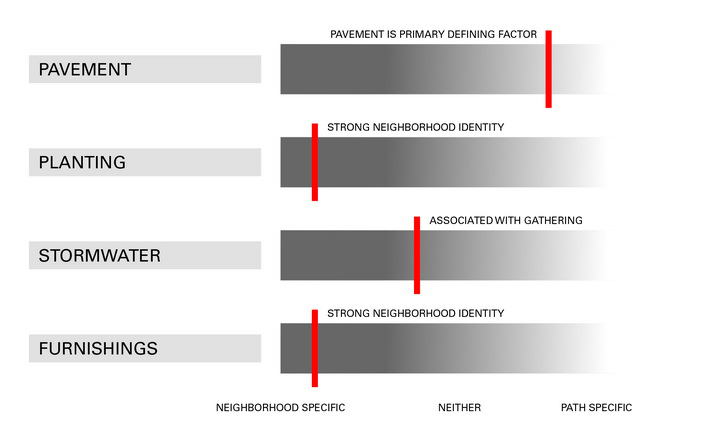
The Greenway will be experienced at times as street, path and/or space, as it reacts with the spatial character of the various parts of the campus. Pedestrians, bikes and vehicles will be appropriately accommodated, with deference to the pedestrian experience.
-
Hardscape

At grade, the Greenway will incorporate a consistent palette of hardscape materials and patterns that is recognizable and selected to encourage sustainability and provide accessibility.聽The north/south and east/west Greenway paths will be slightly differentiated through hardscape materials and trees.
-
Planting

Tree canopy and understory will be neighborhood specific and harmonious, and organized to clearly delineate the path and space of the Greenway.
-
Stormwater

Visible expression of stormwater management will address specific neighborhood conditions within a defined approach and be educationally meaningful.
-
Furnishings

Furnishings, lighting and wayfinding will be neighborhood specific, support the character of buildings and program needs, incorporate sustainability, ensure safe passage and encourage social gathering.