ÌÀÍ·Ìõ

>

Innovation & Design Strategy Minor

Design thinking is a powerful approach to innovation and problem solving that places human needs at the center of the creative process. It emphasizes understanding users, reframing problems, and iteratively developing solutions to complex challenges. By integrating analytical rigor with creative exploration, design thinking helps teams move beyond assumptions and toward solutions grounded in real-world insight. Organizations across academia, government, and industry rely on design thinking to drive innovation, improve services, and create more meaningful user experiences.

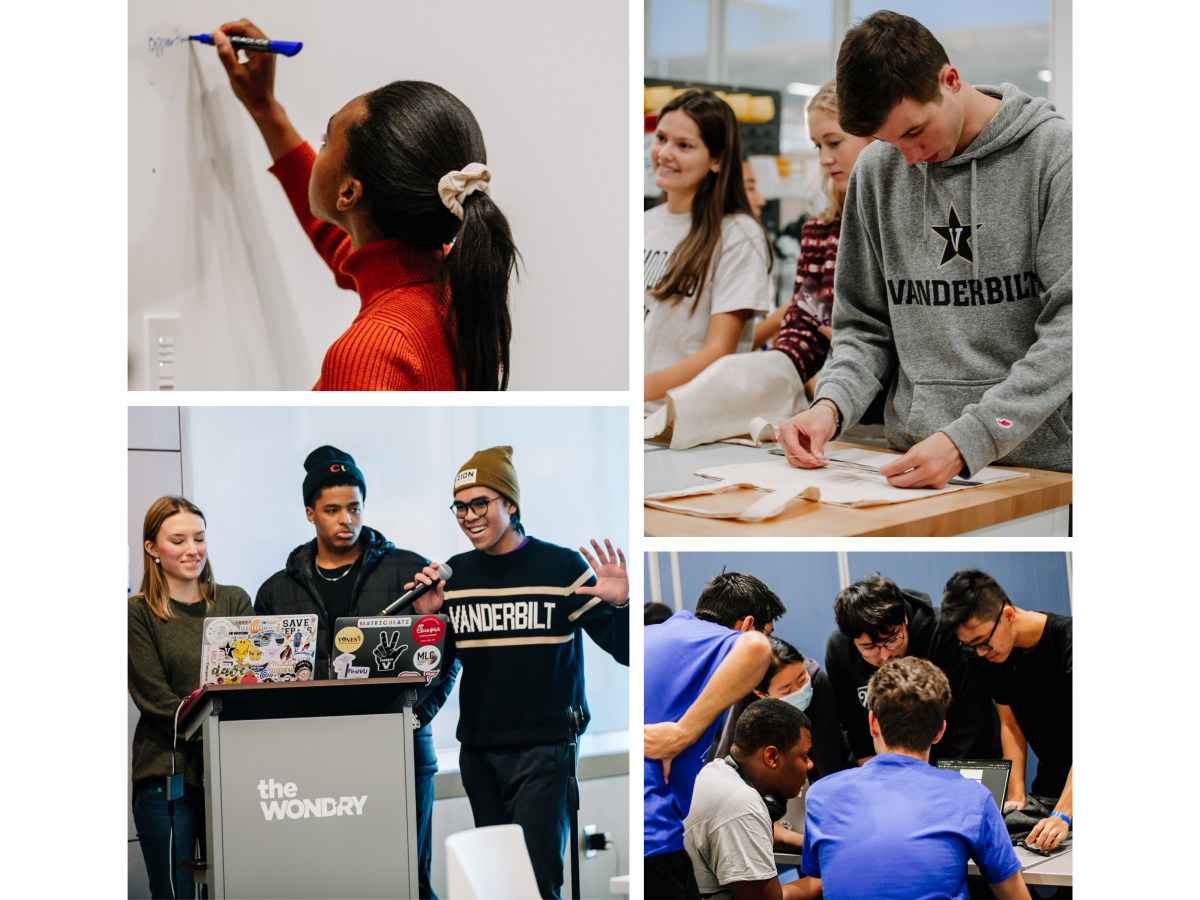
Alex teaching a sewing class

ÌÀÍ·Ìõ the Minor

Open to students from any major, the interdisciplinary Innovation and Design Strategy (IDS) minor introduces the mindsets, methods, and practices of human-centered design. Through hands-on, project-based coursework, students learn to empathize with users, generate and prototype ideas, communicate solutions clearly, and move from insight to action. The minor develops core competencies in visual communication, collaborative teamwork, and critical thinking that apply to challenges in technology, business, public policy, education, and beyond.

The IDS minor prepares students to become adaptable, creative problem solvers across career paths, equipping them with a practical design thinking toolkit and competitive advantage. Graduates develop versatile skills for roles in product design, user experience, social innovation, consulting, research and development, healthcare innovation, entrepreneurship, and related fields.


What is Design Thinking?

Design thinking is a structured approach to creative problem solving that combines analytical rigor with creative exploration. Practitioners observe and engage with users, uncover underlying needs, generate potential solutions, and test ideas through rapid prototyping and iteration.

Organizations across academia, industry, and the public sector use these methods to drive innovation, improve services, and develop products and systems that better respond to human needs.


What You’ll Learn

Through hands-on, project-based coursework, IDS students learn how to:

  • Understand user needs through observation and interviews
  • Reframe problems and identify meaningful opportunities
  • Generate and prototype innovative solutions
  • Communicate ideas through visual storytelling and presentations
  • Collaborate effectively in interdisciplinary teams
  • Move from insight to action through iterative experimentation

Why It Matters

The IDS minor prepares students to become adaptable and creative problem solvers. The skills developed through human-centered design apply across many fields, including technology, entrepreneurship, business strategy, healthcare innovation, and public sector problem solving.

Students graduate with a practical design thinking toolkit and experience applying it to real-world challenges.


Where IDS Can Take You

Students in the IDS minor develop versatile skills that support careers in areas such as:

  • Product design
  • User experience (UX) Design
  • Innovation strategy
  • Consulting
  • Social innovation
  • Research and development
  • Healthcare innovation
  • Entrepreneurship

Students build a prototype mobility device
Students build a prototype mobility device during a Wond'ry-sponsored design challenge.

Course Requirements

Disclaimer: is the official source of program information. If any discrepancies exist between this webpage and the Catalog, the Catalog takes precedence.

The IDS minor requires a total of fifteen (15) credit hours:

  • Innovation Foundation: 3 hours
  • Design Realization: 3 hours
  • Experiential Learning: 3 hours
  • Electives: 6 hours

Applicable Courses

Course and section availability varies each semester.  Some courses may have individual prerequisites.  Please see the for further details.

Innovation Foundation (3 hrs)

  • • IDS 2300 : Design Discovery

    This course offers a deep dive into best practices for engaging in the early stage innovation and design thinking processes. Students analyze problem contexts in ways that make design solutions more likely to be adopted by end-users, including learning how to observe users, ask the right questions, and develop and articulate insights that lead to better solutions. This class is a practical design process course for anyone considering future work in design, including User Experience (UX), Interaction Design (UI), Human-Centered Research and Design (HCR/HCD), technological innovation (R&D), or early-stage entrepreneurial activities.

Design Realization (3 hrs)

  • • IDS 2273/ME2273 : How to Make (Almost) Anything

    Logo for How to Make Almost Anything

    Have an idea but not sure how to build it? This hands-on course introduces you to the tools and techniques of modern prototyping. Hosted in the Wond’ry, you will learn how to move from sketches to physical prototypes using CAD, laser cutting, 3D printing, molding and casting, vacuum forming, electronics, textile fabrication, and other rapid prototyping methods. Along the way, you’ll build practical skills and develop the confidence to experiment, iterate, and bring ideas to life.

    • No prerequisites
    • ALL majors welcome
    • Open to 1st, 2nd and 3rd year students
    • Eligible for Immersion ÌÀÍ·Ìõ (Immersive Experience)
  • • DF 2100 : Rapid Prototyping

    Fundamentals of design, prototyping, and entrepreneurship for all disciplines. Practical aspects of modeling and 3D printing functional parts. Machine elements and metrology to facilitate the design process. Operation of 3D printers and other CNC machines through CAM, slicers, and G-code. Leveraging AI to produce lighter, stronger, and more compact models (generative design). Students print their own prototypes and iterate on their designs.

Experiential Learning (3 hrs)

  • • IDS 2373/ME 2373 : Make It Real and Make It Matter

    Logo for Make It Real and Matter

    Turn ideas into real-world impact. In this immersive, team-based course, students partner with external sponsors to design, prototype, and test solutions to authentic challenges. You’ll learn to translate customer insights into requirements, explore concepts through iterative prototyping, and apply AI tools to enhance the human-centered design process. From concept sketch to refined prototype, every stage strengthens your ability to design with purpose and precision.

    • Eligible for Immersion ÌÀÍ·Ìõ Culminating Experience.
    • Prerequisites: ME 3273 OR DF 2100
    • ALL majors welcome
  • • IDS 3300 : Enterprise Design Thinking

    This hands-on, project-based course takes students through the full Design Thinking process using the IBM Enterprise Design Thinking framework. Working in interdisciplinary teams, students tackle a real-world industry challenge from empathy to implementation, developing skills in research, ideation, prototyping, and testing. By the end of the semester, students gain practical experience applying human-centered design methods to complex problems, preparing them for innovation-focused roles in any field.

  • • IDS 4500/ENGM 4500 : New Product Design and Development

    This project-based course focuses on the methods for managing the design, development, and commercialization of new products. Students will generate product concepts, develop a prototype strategy, model financial returns, explore intellectual property concerns, design retail packaging, and perform market testing to establish an optimal price.

  • • HODC 3262 : Social Entrepreneurship: Principles and Application

    This course explores the idea and practice of "Social Enterprise", an emerging field where new types of organizational models are leveraging business and markets to address important social issues and unmet needs. The complexity of social issues in the 21st century often necessitates innovative, cross-sector, interdisciplinary solutions and organizational forms. Social Enterprise has emerged as one such model with great promise. This course is designed to provide broad exposure to the activity and key issues in the social enterprise sector, as well as a more specific, hands-on learning through projects, case studies and speakers.

  • • HODC 3352 : Philanthropy and Social Problem Solving

    This course provides an opportunity to engage in the practice of philanthropy, while learning about charitable giving/fundraising, social problem-solving, and the non-profit sector. The semester will be divided into four sections: I. Problem identification; II. Approaches to change; III. Evaluating organizational effectiveness/impact and fit with theories of change; and IV. Decision making.

  • • NANO 2500 : Nanoscale Innovation and Making

    Introduction to nanotechnology from concept through commercialization. Case studies, overview of nanofabrication methods, entrepreneurship, and business strategy. Includes hands-on project in the VINSE facilities and development of a product pitch.

Electives (6 hrs)

Note: If more than one course from the Design Realization and/or the Experiential offerings is completed, then the additional course(s) will count towards the elective requirement.

School of Engineering Electives

  • • BME 3800 : 3D Computer Drafting in BME Design

    Development of 3D visualization skills to transform ideas into parts, engineering drawings, and assemblies in SOLIDWORKS. Projects emphasize applications in biomedical engineering.

  • • BME 3302 : Instrumentation II

    Systems-level approach to the design of devices that monitor clinically-relevant physiological functions and variables, driven by the needs of specific pathophysiological conditions.

  • • BME 3890 : Special Topics - Mobile Health: Hardware and Firmware

    Smart Healthcare Technologies have the potential to improve patient care and reduce healthcare cost dramatically. Smart healthcare uses wearable, connected, low power advanced sensor technologies and embedded systems in combination with intelligent feature extraction and internet technologies for a better delivery of patient care services. This course focusses on hard and firmware aspects including sensor technologies, microcontroller, system integration and firmware development.

  • • CE 2120 : Sustainable Design in Civil and Environmental Engineering

    Concepts and methods of sustainability; resilience in civil engineering design. Best practices. Economic, social, and environmental analysis. Ratings, indices, and measurements. Local, regional, and federal policy. Challenges posed by climate change. Sustainability and resilience rating systems. Applications to development and design.

  • • CHBE 4200 : Additive and Polymer-based Manufacturing

    Scaling up prototypes through industrial processes. Operating principles of advanced forms of 3D printing (stereolithography and powder bed fusion). How properties of polymeric, ceramic, and metallic materials inform the 3D printing process and certification of printed parts. Computer-aided modeling of manufactured parts with a focus on minimizing anisotropic properties and dimensional instability. Fundamentals of polymer melt flow and simulation in mold cavities to optimize part fabrication. Students design a prototype injection mold and iterate on their design using flow simulation software and 3D printing.

  • • DF 2100 : Rapid Prototyping

    Fundamentals of design, prototyping, and entrepreneurship for all disciplines. Practical aspects of modeling and 3D printing functional parts. Machine elements and metrology to facilitate the design process. Operation of 3D printers and other CNC machines through CAM, slicers, and G-code. Leveraging AI to produce lighter, stronger, and more compact models (generative design). Students print their own prototypes and iterate on their designs.

  • • DF 3890 : Special Topics - Subtractive Manufacturing

    Principles of high-speed machining and subtractive manufacturing with a focus on CNC milling, laser cutting, and plasma cutting. Fundamentals of tooling, fixturing, and optimizing cutting parameters (feeds and speeds) for precision machining. Computer-aided manufacturing (CAM) and simulation to develop toolpaths and improve efficiency. Students gain hands-on experience with 2D cutting operations before programming and operating a 3-axis milling machine with a high-speed spindle. Emphasis on problem-solving, process optimization, and design iteration. Students design and machine their own prototypes.

  • • ENGM 2210 : Technology Strategy

    Critical issues faced by chief technology officers. Assessment of technological capabilities and opportunities, formulation of a technical plan for the product portfolio and commercialization, management of intellectual property, and economic analysis.

  • • ENGM 3000 : Enterprise Systems Design

    Design of complex enterprise systems and processes including enterprise requirements analysis, process-mapping, modeling, performance measurement, benchmarking, solution development, and change management.

  • • ENGM 3010 : Systems Engineering

    Fundamental considerations associated with the engineering of large-scale systems. Models and methods for systems engineering and problem solving using a systems engineering approach.

  • • ENGM 3300 : Technology Assessment and Forecasting

    Methods of forecasting technological advancements and assessing their potential intended and unintended consequences. Delphi method, trend exploration, environmental monitoring, and scenario development.

  • • ENGM 3350 : Organizational Behavior

    Study of the factors that impact how individuals and groups interact and behave within organizations, and how organizations respond to their environment. Motivation theory, communication within organizations, group dynamics, conflict management, decision making, power, strategic planning, organizational culture, and change. Focus on utilizing analytical tools to understand organizations: symbolic, political, human resources, and structural.

  • • ENGM 3600 : Technology-Based Entrepreneurship

    Identification and evaluation of opportunities: risks faced by entrepreneurs, market assessment, capital requirements, venture capital acquisition, legal structures, tax implications for sharing technology-based businesses.

  • • ENGM 3650 : Operations and Supply Chain Management

    Manufacturing strategy, process analysis, product and process design, total quality management, capacity planning, inventory control, supply chain design, and advanced operations topics. Modeling and analysis using cases and spreadsheets.

  • • ENGM 3700 : Program and Project Management

    Scheduling, cost estimation/predictions, network analysis, optimization, resource/load leveling, risk/mitigation, quality/testing, international projects. Term project required. Provides validated preparation for the Project Management Institute CAPM certification for undergraduates or the PMP for graduate students.

  • • ENGM 4500 : New Product Design and Development

    This project-based course focuses on the methods for managing the design, development, and commercialization of new products. Students will generate product concepts, develop a prototype strategy, model financial returns, explore intellectual property concerns, design retail packaging, and perform market testing to establish an optimal price.

  • • ENVE 3610 : Sustainable Development

    Quantitative investigation of the role of adequate and renewable resources for continual economic development. Past and present resource challenges, influences of indigenous, national, and international cultures, land use practices, social policy, and economic strategies on infrastructure development. Future challenges posed by climate change, and how market- and government-based policies may be applied in conditions of uncertainty to encourage sustainable development.

  • • ES 3890 : Special Topics - Prototyping Hardware Tech

    Rapid advances in electronics, automation, and connected devices are reshaping industries worldwide.  This course addresses the growing demand for professionals who can bridge the gap between concept and manufacturable product by empowering students with both the technical foundations and the collaborative, documentation, and outsourcing skills essential to real-world product development.  Students gain a competitive edge in fields ranging from consumer electronics and IoT to biomedical devices and sustainable technology-sectors driving innovation and shaping the future economy.

  • • ES 3890 : Special Topics - Wearable Product Design

    This course explores of the dynamic intersection of the human body, technology, and design through a human-centered design process. Students will develop skills in textile identification and pattern drafting and draping for fit, comfort, and movement applied to the research, design, and prototyping of innovative wearable products that integrate emerging technologies such as smart materials, sensors, and responsive systems. Students will critically examine how fashion, product design, and technology converge to redefine the relationship between humans and wearables, with particular emphasis on sustainability and adaptive, universal design solutions.

  • • ME 2160 : Introduction to Mechanical Engineering Design

    Design fundamentals, computer-aided design, machine fabrication techniques, technical drawing, team-based learning, and a comprehensive design project.

  • • ME 3204 : Mechatronics

    Design of analog and digital electromechanical sensors and actuators, signal and power electronics, and application of digital microcontrollers to mechatronic systems.

  • • NANO 2500 : Nanoscale Innovation and Making

    Introduction to nanotechnology from concept through commercialization. Case studies, overview of nanofabrication methods, entrepreneurship, and business strategy. Includes hands-on project in the VINSE facilities and development of a product pitch.

College of Connected Computing Electives

  • • CS 4247 : Data Visualization

    Visualization analysis and design. Perception, color and multiple-view design, interaction, and task analysis for visualization. Techniques for visualizing geographic data, networks, hierarchical and high-dimensional data, and uncertainty.

  • • CS 4249 : Projects in Virtual Reality Design

    Students work in groups on specification, design, and construction of complex immersive 3D virtual environments. Includes modeling, interaction, usability, rendering, perception, and tracking.

  • • CS 4376 : Foundations of Human-Computer Interaction

    Skills and concepts of Human-Computer Interaction (HCI) to enable the design of systems that effectively meet human needs. Social, cognitive, behavioral and contextual aspects of information systems. Informational dimensions of the human-computer interface, and other user-centered design concepts. Includes conceptual problems in HCI and design approaches to interactive prototype construction and evaluation techniques.

College of Arts & Science Electives

  • • ARTS 1505 : Graphic Design: Form

    Design studio investigating the creation of visual messages across print and digital media. Core skills of visual communication - abstraction and composition - through an understanding of visual perception. Experimentation across digital technologies and analog ways of making.

  • • ARTS 1515 : Graphic Design: Typography

    Design studio investigating the visual form, material, and distribution of language. Core skills of typographic expression - hierarchy, legibility, and reproducibility - through an understanding of the history of print and digital publication methods. Experimenting across digital technologies and analog ways of making.

  • • ARTS 2505 : Graphic Design: Systems & Structures

    Advanced design studio investigating design principles of organization across a range of scales. Deepening design skills through projects including information architecture, the creation of typographic systems, and exhibition display strategies. Design as a means for transformation.

  • • ARTS 2515 : Graphic Design: Practicum

    A design studio focused on the collaborative creation of real-world projects. Students gain experience taking a project from concept to implementation. Orientation to working in a design studio context.

  • • CMST 3800 : Art, Media, and Advocacy

    Design as communication and activism. Student-designed research and creative projects aimed at social and cultural change.

  • • CSET 3257 : Virtual Reality Design

    Interdisciplinary, project-based introduction to Virtual Reality (VR). Creation of immersive environments. Student projects guided by faculty mentors to create real-world, consequential VR simulations relevant to, and innovative in, their respective fields.

Peabody College Electives

  • • HOD 2500 : Systematic Inquiry

    This course offers an introduction to social science research methods covering qualitative and quantitative approaches. Students will develop the ability to critically analyze research studies as well as collaborate with others to conduct studies of their own, reporting their results in a professional format.

  • • HODC 3202 : Community Development Theory

    This is a core course in the Community Leadership and Development (CLD) track of the HOD undergraduate program. It is designed to provide a general introduction to the field of community development (CD) by examining appropriate theoretical perspectives. Ecological theory, critical theory, and theories of democracy will be studied for their application to community development issues. The theoretical perspectives examined in the course will also be linked to the diverse fields which inform community development, such as community psychology, sociology, geography, anthropology, education, and planning. Additionally, the course will provide students a more in-depth understanding of particular community development issues by exploring how alternative theoretical perspectives interpret several important community development phenomena. The course will prepare students to understand the theoretical orientations that underlie the dynamics of community development.

  • • HODC 3262 : Social Entrepreneurship: Principles and Action

    This course explores the idea and practice of "Social Enterprise", an emerging field where new types of organizational models are leveraging business and markets to address important social issues and unmet needs. The complexity of social issues in the 21st century often necessitates innovative, cross-sector, interdisciplinary solutions and organizational forms. Social Enterprise has emerged as one such model with great promise. This course is designed to provide broad exposure to the activity and key issues in the social enterprise sector, as well as a more specific, hands-on learning through projects, case studies and speakers.

  • • HODC 3352 : Philanthropy and Social Problem Solving

    This course provides an opportunity to engage in the practice of philanthropy, while learning about charitable giving/fundraising, social problem-solving, and the non-profit sector. The semester will be divided into four sections: I. Problem identification; II. Approaches to change; III. Evaluating organizational effectiveness/impact and fit with theories of change; and IV. Decision making.

  • • HODC 3650 : Community Leadership and Development Seminar - Building a Design Driven Culture

    Exploration of selected topics related to the community leadership and development track of the Human and Organizational Development Program.

  • • HODH 3221 : Health Service Delivery to Diverse Populations

    This course focuses on the study of value systems of diverse groups, as well as variables related to gender, age, lifestyle, religion, social class, race, geography, and developmental state, and how these relate to health status and health service needs. This course provides students with a basic knowledge and understanding of diversity so that they may be more effective in serving the needs of all people.

Owen Graduate School of Management Electives

  • • BUS 2320 : Innovation Strategy

    What makes some organizations more innovative than others? In this course, students will learn how to improve an organization's innovation capabilities. Major themes include how to foster innovation within the firm, how to commercialize innovative ideas through new products and services, how to protect innovation from competitors, and how to overcome common barriers to innovation. Students will also improve their own innovation abilities through a project in which they pitch a new product or service. Note that while we will discuss examples of technical innovation, this is not a tech course; rather, this course is about how to create an effective strategy for innovation in a wide range of organizations.


Additional Assistance

For any additional questions regarding the Innovation & Design Strategy Minor, please email thewondry@vanderbilt.edu.