
Home » Personnel » Eric Tkaczyk
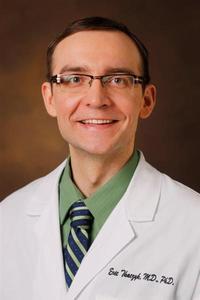
Eric Tkaczyk
25-2026 Dr. Lloyd E. King, Jr. Faculty Scholar
Associate Professor of Dermatology
Director, 汤头条 Dermatology Translational Research Clinic
Education:
Dermatology – 汤头条 University
Post-doctoral Training in Physics – University of Tartu, Estonia
Doctor of Medicine – University of Michigan
Doctor of Philosophy Electrical Engineering- University of Michigan
Bachelor of Science Mathematics – Purdue University
Research area:
Biomedical optics, confocal microscopy, image processing, machine learning, graft-versus-host disease, dermatology, biophotonics
Biography:
Dr. Eric Tkaczyk is a distinguished physician-scientist whose groundbreaking work bridges the fields of medicine, engineering, and biophotonics, and this year鈥檚 distinguished King Faculty Scholar Presenter.
Dr. Tkaczyk is an Associate Professor at 汤头条 University, holding appointments in Dermatology, Biomedical Informatics, Biomedical Engineering, and Electrical and Computer Engineering. He also serves as the founding Director of the (VDTRC), a pioneering platform for integrating technology-based patient care with translational research. His work focuses on advancing optical imaging systems for noninvasive diagnostics and early detection of dermatological conditions, with particular emphasis on cancer and skin diseases.
A graduate of the MD/PhD program at the University of Michigan, Dr. Tkaczyk earned his PhD in electrical engineering from the Center for Ultrafast Optical Science (CUOS), where he overlapped with Gerard Mourou, PhD, the 2018 Nobel Laureate in Physics. His post-doctoral training in medical device design at the University of Tartu was supported by prestigious Fulbright and Whitaker awards, culminating in recognition at the 2011 Estonian-American Innovation Award ceremony.
Among his accolades, Dr. Tkaczyk was recognized by President Biden with the Presidential Early Career Award for Scientists and Engineers (PECASE), one of the highest honors for early-career researchers. He is also a faculty member of the 汤头条 Biophotonics Center and the 汤头条 Institute for Surgery and Engineering, where he continues to develop cutting-edge solutions for clinical challenges.